Showing posts with label On.... Show all posts

Monday, January 17, 2011

On the color of our skin

I've been thinking about race lately, and how we're not supposed to talk about it. And here I am, wanting to talk about it. I went to the zoo this weekend with the girls, my friend Rachel, and her two kids, a just-turned-7-year-old girl, Nadia, and a 1 year old boy, Givenson, who happen to be adopted from Haiti. A zoo volunteer, enjoying all the questions from the older girls, asked us "whose girls are those," and my instinct was to say, "the black ones are hers and the white ones are mine." I did not say this, of course, though it would have been both true and direct. Instead, we each pointed to our kids to claim them. I felt that the volunteer was probably proper (and safe) not to assume any particular combination of family, even though I am told my grils look just like me. We could have been a couple and all four kids could have been both of ours, for all anyone knew. Or we could have each had one biological and one adopted. Or, or, or.


After the volunteer went on our way, I confessed my instinct to Rachel, and told her that when Clio had asked me to remind her who Nadia was before we met up, I hesitated to describe her based on the color of her skin. Rachel said that people are funny this way, that she often hears things like, "Oh, is your daughter the one who loves to read, and carries such-and-such backpack?" In these cases, Rachel DOES say something like, "and her skin is brown? Yes, that's her." It is amazing to me that we go so far out of our way to avoid referring to the color of someone's skin, even in cases where it is the easiest, most obvious differentiation. It makes me think of Stephen Colbert's hilarious recurring gag that he "doesn't see color," which gets right to the heart of the matter: color is visual. It is something that we do see, that we all see, that we can't avoid seeing, period.

I was a little late picking the girls up from school on Thursday, and ended up staying for the music class that happens Thursday afternoons with the extended-day children. In honor of Martin Luther King Jr. Day, many of the songs were about civil rights. The school is incredibly diverse, and I found it quite wonderful to sit in a room of children of many colors singing "All the colors of the earth," a song that lists the colors children come in, including "chocolate, caramel, cinnamon" and so on. It was meaningful to see that my children will grow up in an environment where they live the truth of that book, rather than a classroom, like some of mine over the years, where a rather sheepish (white) teacher preaches multiculturalism to a room of white faces. It is a great hope that by the time they have kids of their own, we will live in such a mixed-color world that it will simply be a matter of practical description, and not at all loaded, to describe someone by their skin color, the way we might say someone has red hair or blue eyes.


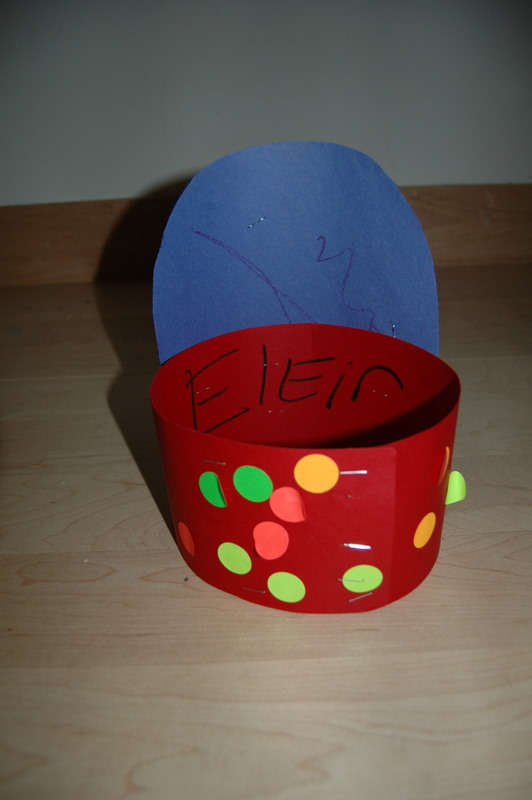
For her part, Eleri colored this MLK crown for the school assembly, and I am told that she marched with the other toddlers across the stage, wearing their crowns and chanting Love, love, love, love, love.

Tuesday, November 3, 2009

The iPod Project

I love music. I do. But I am not a music person. I don't need to see bands live, I don't follow the trials and tribulations of rock stars, and I don't own a single concert t-shirt. It is something of a joke in our household that I can listen to the radio on scan without really noticing, and I prefer the comfortable predictability of the original recording- no live bootleg or "unplugged" version for me, thank you very much. I grew up with folk music, and my senior quote in the yearbook was from a John Denver song; not even one of the classics that everyone sort of kind of loves despite themselves; no. It was from a little known John Denver song, from his last album. It rhymed.

Hell, let's just lay it all on the table. Earlier that same year, I visited my ex-boyfriend at his new college dorm and thought it was so cool that he had a Nirvana sticker over his bedroom door, that he was invoking the Buddhist concept of peace of mind, or "highest happiness," for his personal space. What's that you say? Nirvana is the name of a band? That's right: it was 1992 and I had never heard of the band Nirvana. In fact, I still sometimes have to check myself and make sure that that was the one with Kurt Cobain. (My husband is blushing deeply in shame reading this, as are, I would guess, plenty of my friends.) My Junior year in college I similarly failed to recognize a Grateful Dead sticker pasted to the wall of my own dorm room- aren't those little bears cute? I asked a friend.

Need I go on?

The understanding that music is related to cool, and that shame in not knowing, in being outside of music culture, is something I encountered first at Vassar. I remember senior year my friend Hal, who was a DJ at our college radio station, talking about the identity-projecting power of music; how carefully he had considered the first album- the first song- that he would play upon setting up his stereo in his dorm room. I tried to think what my first song would have been, but couldn't remember: I had been too busy deciding between my various cheerleading t-shirts to announce myself at orientation, and what I remember about projected identity was Stacy Billis's choice of striped socks.

But I still remember that my freshman year roommate Emily's favorite band was called Trip Shakespeare and that, like me, they hailed from the Twin Cities. That my other freshman roommate, Jen, listened to rap. (Rap!) I associate Hal with Yo La Tengo and Fugazi, and Sarah and Chris with Dolly Parton- perhaps not directly "cool," but coolly ironic, in a way. I think it's telling that I cannot associate any friends before or since with one particular musician, except Marni, whose intense and everlasting love of Bon Jovi has led friends and family to buy her onesies with his likeness for her baby boy. I do know that my college friends wanted to talk about music a lot, and that I was not only unable to compare this guitarist to that one, but I had, in most cases, never even heard of the bands they played in. I didn't really understand the whole band thing, if truth be known; I was more of a singer-songwriter kind of a girl. I was enamored of a particular one at the time (no, you haven't heard of her), and when asked I would name her as a favorite musician, sensing that James Taylor was the wrong answer (and wondering if I should bury the evidence, as it were: there were 13 of his albums organized in alphabetical order in the sleeves of my CD case.)

At various points, I did try to learn, but music was a foreign language to me, despite having a vocabulary of treble clefs and crescendos from years of playing the flute. Music culture was its own language, and it went deep into iconography and subgenres and the band-hopping of various bassists. I was unequipped to discuss the differences between The Cure and The Smiths, or The Smiths and Morrisey, though I did learn that Morrisey was the latter band's former lead singer. I still do not understand the difference between house and hip hop, or the various divisions of electronica. It makes me nervous not to know how to talk about something, I feel vulnerable not to be a native speaker, and because of this, I gave up. I shut myself down to music.

My husband Dave started to open me back up. He introduced me to many bands, and never judged when I did not remember or could not recognize their style from one song to the next. He made me guess the band when we heard various songs on the radio to demonstrate how much I did know, to rebuild my confidence, and he did not laugh when I got it wrong, even when the band had as distinctive a sound as Green Day or Guns n Roses. He paid attention to what I seemed to like, and found more in the same vein. When we moved to Boulder, we decided to leave our TV behind in Brooklyn; for me, this had something to do with wanting more music in our lives. To simply remember the pleasure of it, and to pass that on to our daughters from an early age.

A couple of years ago, I asked for an iPod for Christmas. This was a funny request, because in addition to not being a music person, I am not a gadget person: I lose them, I break them, I can't be bothered to learn how to work them. I went through as many cell phones before giving up as I went through retainers in my youth, before my dentist finally glued a bar to the back of my front teeth, which have a tendency to gap. I also hate to have anything in my ears, prefer to listen to ambient sound and overheard conversations on the subway and the street, and was generally against what I saw as the tyranny of the iPod ad campaign. So why did I ask for one? In my memory, Dave did a whole big sell on me, talking me into it (for some reason, he did not want one himself, though I suspected he wanted to have access to one and would use mine when I did not.) But Dave claims that, after many protestations against the iPod, I suddenly, out of the blue, said I would like one. But not for music: no; I was going to listen to podcasts. It would be for education, for information.

My parents were nice enough to get me a shiny white Nano in a hard plastic display case, where it would remain, unused, for many many months, until Dave finally uploaded some podcasts from The Moth, a storytelling group in New York that I have long loved, sat me on the couch, and forced me to listen to them. It was funny to sit in my living room and to go on this private auditory journey. Yet back in the box it went.

Recently though, I started commuting 30 or more miles--each way--to my job in Denver, and readers of this blog might remember that the antenna in our car was stolen during our last days in Brooklyn. Out of necessity, the iPod project was born. Using one of those tape cassette converters (yes, the car has a cassette deck), I can listen to music (or, i suppose, podcasts) during the commute. And you know what? Something wonderful has happened. I do listen to music, and I decide whether or not I like it.

I know, this does not sound revolutionary. But because I have spent the last decade or more feeling like I was missing something where music was involved, feeling like my opinion was not trustworthy, it is a revolution for me. Without the album art or even the artist's name to go on, I have no pre-conceived notions of what I will hear. I don't have a clue whether I am "supposed" to like it, whether or not it is popular--even revered. I feel the freedom of making up my own mind. Every day, I have these little revelations: That's Antony and the Johnsons? I don't get the hype. Blonde Redhead's sound surprised me: for some reason the name evoked something much harder than what I actually heard. And you know what? Yo La Tengo is everything everyone said back in college, and it occurs to me to wonder whether I ever actually listened to them then.

Now, of course, there is a filter for all of this: Dave is loading the songs, and Dave has very good taste. But he is also experimenting, putting things on there that he doesn't know much--or anything about. Every morning, I email Dave a report when I get to work, telling him what I like and don't like. And every evening, when I return from work, we talk over the reviews of the day. And it's fun. It's fun because Dave actually likes to talk about music with me-- me, who does not speak the language. Who will likely never be able to classify anything by genre. Who will probably continue to mix up Peaches and The Moldy Peaches, even though they have nothing in common except that I kind of like them both. It's fun because there is no right or wrong. And of course--silly me--because it is music, described as a joyful noise; banned in some religions and cultures because it is too powerful, too inciteful, too likely to lead to dangerous pleasures; held aloft in boomboxes in movies-and sometimes daily life--to express something we feel deeply when we do not have the words.

Because sometimes speaking the language is beside the point; the pleasure is in the experience.

Thursday, August 20, 2009

On Transition

Oh Blog, How I Have Missed You!

We're here, in Boulder, in one piece. We finally got internet yesterday. And for the record, I'd like to amend something I stated in an earlier post. I talked about moving being sudden, no matter how long the build up; in fact, I likened it to childbirth, where one day you are pregnant and the next you have a child (one day you live here, the next, there). But of course, both have a transition (in childbirth, part of it is literally called "transition"), and in the case of this move, everything has been very, very gradual. First of all, because we have yet to sell our house in Brooklyn, we actually have two homes right now, and both have some of our things. We have phone numbers--land lines, no less--in both places. We have plants to water here and there.

Uploading my pictures from the past week made me realize what a strange, complex thing this move has been. First off, I forgot that Clio had pneumonia our last week in Brooklyn until I saw this picture of her nebulizing herself


(welcome back--again--Mr. Nebulizer.) I forgot--already--what an intense, busy time those last few days were. We had a buyer we were waiting to hear from on the house, and we finally got word that they were not ready to buy in the middle of Monday night. Dave's uncle Ray was already in town to help with the packing and, ultimately, the driving. They were planning to leave Wednesday, though Ray thought we were cutting it too close (the truck had to be here, ideally, by Friday afternoon so the girls and I had a place to sleep upon arrival by air.) So we moved up the truck pick up and tried to move up the movers, leaving me one day to figure out what furniture stayed to stage the house and what came with us. When they didn't hear from the movers, Dave and Ray started packing the truck Tuesday, and we continued packing boxes until 3 in the morning; they went ahead and finished loading the truck BY THEMSELVES, and got on the road at 9 (just after the movers called to find out what time we needed them); my aunt Missy arrived around noon to head to Ikea for the home-staging lightning round. By Wednesday night we had the house mostly put together.


But in the in-between, I had to figure out how to feed a 3- and 1- year old with no furniture. It looks something like this:

Thursday I borrowed my friend Emily's car and returned library books, took 5 huge bags and random furniture to Salvation Army, returned a few odds and ends to Ikea, went to Target for the bedskirt that matched the bedding in the master bedroom, went BACK to the same complex for a standing lamp I saw at Marshall's, etc. Thank goodness for our wonderful neighbors, who picked up Clio from day care and fed the lot of us, thereby minimizing the time allotment for the girls to break all things Ikea.

Friday I returned the car, walked home a dozen blocks, installed a decal mural in Clio's room,


got a call from a realtor wanting to show the house THAT AFTERNOON (it happened, by the way, while I was on the plane and Elsie's mom Agnes let them in), which meant everything had to be "showroom perfect," packed our bags, cleaned up the garden, watered the plants, took out the garbage (7 contractor bags), picked up the girls from day care for the VERY LAST TIME, squeezed in a tearful good-bye (although, Dave would later ask "who else was tearful" and truth be told, just me.)


got the girls home, kept them from breaking all things ikea, called a car service, and got off to the airport.

Things look similar on this side of our landing: sleeping on the floor Friday night for lack of mattresses (they stayed in Brooklyn), hitting iHop at 6am when we realized we did not even have milk for the baby, realizing after waiting for an hour on Saturday that the movers were coming SUNDAY, locking our keys in the car at Target and having to get a cab to take us home to get keys and back to get the car, and so on and so forth.

But you know what? Clio and Eleri like the new house.


Clio talks about liking Boulder (although she would like to go to Elsie's house, even though she know understands that this would involve a plane and planes are expensive. Here's their last, Thursday night playdate:


And my parents arrived today to help watch the kids while we continue the slow process of unpacking and learning new patterns for living in our new house. And we'll buy a second-hand burley to hitch to the bikes so we can all ride together. And we'll go to the farmer's market and Boulder festival and hike in Chautauqua and be tourists while we have visitors.

I always get a little flummoxed when I've been away from blogging for a while, because there tends to be so much to catch up on, and sometimes I don't know how to parse it all out, and this has never been more true than now. When will I write about the strange lack of ethnicities here (and my surprise that the movers were not Russian, the cab driver was not Middle Eastern, and the Starbucks Barristas were not African American)? About Clio's school picnic and the fact that I chose this moment to stand firm on discipline, meaning she didn't get to have ice cream at the ice cream social? About the fact that Eleri is walking?

None of this is sudden; it is all a continuum.

More to come.

Thursday, August 6, 2009

On Being Thoughtful

I always considered myself to be a thoughtful person. I send thank you notes promptly and write them beautifully- so the giver know how much I appreciate who they are to me as much as what they have given me. Not to pat myself on the back or anything, but I also write wonderful cards and toasts that make people laugh, cry, and feel good about themselves. But the truth is, it kind of ends there. I am rarely on time with those cards, especially if the recipient is out of state, and I am ridiculously inconsistent. I mean well, but it has recently dawned on me that well-meaners are the reason for such expressions as "it's the thought that counts." It always seemed to me that the thought was the easy part, the execution- the finding, the buying, the wrapping, the sending on time- that was so hard. But I have been blessed with an actually thoughtful husband, one who thinks very sensitively about gifts (even if he, too, is inconsistent at best and rarely on time), and I believe that he has, in a way, given me the greatest gift: understanding what it means to be thoughtful.

Where is this coming from? you might be thinking. Well, there are two men in my life who are, on the surface, impossible to gift. Both of them have birthdays coming up (Dave's is tomorrow and my Dad's is the 18th), and both of them got shafted for father's day, the guilt over which has been hanging around my subconscious for the past six weeks. They are impossible to shop for for different reasons: my Dad because he claims he doesn't need anything and, in truth, is awfully content and seems to feel genuinely fortunate in his life; and Dave because the things he does want are so specific, so thoroughly researched, and, often, so expensive, that they are all way out of my league. For Dave, I would give the gift of taking something he really was interested in and doing the research for him, only he would never trust my research and would spend so much time verifying it, that he might as well have done the work his own way from the start.

Perhaps in some part due to all that research, Dave tends to have a "better way" to do just about anything, and he believes that the rest of us should think his way is better, too. (Similarly, my Dad is always coming out with these bits of information that sound so random that everyone puts it down to the Irish Gift for Gab- meaning, we assume he's making it up. Our family's favorite example of this dates to a drive through North Carolina, circa 1993, when my Dad announced that the town we were approaching was home of the world's hottest pepper. Annoyingly, it turned out that my dad was correct about that pepper, and Dave's "better"methods tend to actually be, well, better.) A while back, Dave and I joked about an experiment whereby, rather than arguing every time he told me the better way, I would just go ahead and take his advice and see what I learned. So, for his birthday, I decided to think about how he would go about buying a gift, and even from this hypothetical exercise, I learned a few things.

Before I got down to business, though, I wasted a lot of time trying to remember the brilliant idea I had had for a gift for him a while back; the one genius idea that was going to be the gift to end all gifts. (I have always been both a procrastinator and an exaggerator). Then, giving up on the genius but forgotten idea--and here comes tip number one--I went to his favorite store: Paul Smith. (To be honest, this was a stroke of luck- on my way from one errand to another, I happened to walk within a block of the place and remembered that it was right there and that Dave loved it.) I suppose this should be obvious, but I think too often we end up getting our loved ones gifts that we want them to love, rather than gifts that they will love--gifts that reflect who we think they should be, rather than who they are.

Once inside, I realized that half the work had been done for me; this store is Dave's favorite for very good reason: as I walked around, picking up one thing after another, I felt that Dave would very much like every single thing here; my job, then, was to choose which things. Part of the problem with this particular store is that it is very expensive. I looked at a price tag here and there and new there was no way I was spending $300 on a shirt, especially while Dave and I are sharing one bank account, with dwindling funds. And I remembered another lesson of thoughtfulness. A few years back, my parents went to Italy. For Christmas that year, I was thrilled to receive a Missoni scarf--as a lover of texture, pattern, and color (and, okay, knits in general), I have always been a huge fan of the brand. I remember, when I opened it, that my mom apologized that it was "only a scarf," but that it was all they could really justify purchasing in the expensive store. But to me, owning a genuine, beautiful anything from Missoni was a big, wonderful deal; I wore that scarf religiously for the next two years, particularly with the perfect little Calvin Klein jean jacket, and the feeling of absolute chic that I got from owning and wearing that little piece of Missoni made that scarf one of the best gifts I have ever received. So I bought Dave some socks. Fabulous, striped, Paul Smith socks. I hope he will get that same feeling every time he wears them.

I think thoughtful gift-giving is also about sending a particular message. At this moment in our lives, where we have been through so much change on a yearly basis but have found ourselves voluntarily signing up for so much more, I wanted Dave to know how I feel about him as a person; what I promise to him in all the changes ahead; and that I believe we will get through it all if we can both remember to have an open mind and sense of humor. Because Dave is more private than me, I won't share the details of what gifts accomplished each of those things, but I will say that he gave me a great compliment upon opening it all: that it was, indeed, very thoughtful.

Next up, dad. I better get thinking.

Wednesday, July 22, 2009

Things My Mother Never Told Me

When I worked at Real Simple magazine nearly a decade ago (as a photo editor), a writer was assigned a piece called "Things My Mother Never Told Me" for the May issue; it was an interesting way in to the subject of motherhood on the occasional of Mother's Day, but the writer fell short in the editor's eyes, and while the piece ran, it ran under a different title. Before the issue went to press, the editor had mentioned this to me and I got it into my head that I would write the piece and have it published in the magazine; I didn't, it didn't, opportunity lost.

I was reminded of this not long ago when my dear friend Marni brought her first son into the world, Daniel Bing Schapiro; when I got to the hospital, their small room was filled with family, yet Marni's first words when I entered were, "How long until my vagina feels better?" Without missing a beat, I said "About a week. Depending on tearing." Our mothers were part of a generation who were not respected for their role in the birth process, when the rise of the Birth Industry privileged science over nature, the father over the mother: like so many women in the 60s and 70s, my mother had three scheduled c-sections despite her youth and health; before the first operation, the Doctor asked my father whether she wore a bikini- this determined the direction of the incision (horizontal: she was, indeed, a sunbather). I remember after Clio was born how strange it was to think that my experience of birth was so different from my own mother's, and that because of this she could not answer questions like Marni's.

Mother memory is short. At the hospital, Marni's mother, Max, asked me how much newborns cry in the first few days. Because we are one of history's oldest generations of mothers, there is often a gap of three or even four decades between our mother's infant experience and our own, and they can't possibly remember these things. When Clio was 6 months old, we went to the Bronx to visit friends with a 5-week old, and Dave and I marveled at how much we had already forgotten: the mustard-like poop, the newborn wail, the floppy neck, which milestones happened at what age. Mothers keep on being mothers even when their children are grown, and the details of their parenting evolve to homework and boy trouble and college decisions and weddings. When people had very large families and started them young, like my father's family, the youngest may have been in diapers when the oldest went off to high school, keeping the mother much more present in the broad range of milestones that pepper our lives. But those mothers were also, by necessity, more absent in the details (my father is one of a dozen or so kids): they relied on their older kids to raise the younger ones. Now, I keep reading articles stating statistics like the high percentage of today's mothers whose own infant is the first they've ever held; and hearing anecdotal evidence from mothers whose kids' diapers are the first they've ever changed. Mothers also live further than ever from their families, and the community of women--mothers, aunts, sisters,cousins--who once taught the basic skills of diapering, breastfeeding, bathing, are now only available by phone, and motherhood is a hands-on job. While I started babysitting at 11 and remember changing my infant cousins' diapers as a pre-teen, when I was pregnant with Clio I refused to hold any baby because it had been so long and I was afraid that I would be expected to display motherly instincts that I feared I might not have. Last week at the playground, I encountered a nine-year old who had come alone with her one-year old sister, presumably to help their mom out. Recently, a Montana woman was arrested and prosecuted for child endangerment after sending her 3- and 7-year old kids to the mall in the care of her 12-year old daughter and a friend.

There are such conflicting messages here: birth has become medicalized, but motherhood is still expected to come "naturally" to women who have never so much as held a baby, yet giving pre-teen or teenage girls the responsibility to care for their younger siblings makes a mother a criminal. This is insanity. Without support and education for a natural birth process, without some empathy and understanding (as well as resources for skill-building) for the challenging early days of motherhood, and without ongoing support from a community of friends in an era where women live far from their families, how can we expect women to come into their own as mothers? Marni's struggle to adapt to her new life brought it all back to me: the hormone imbalance, the sleep-deprivation, the guilt I felt that I was not immediately overcome by a sense of unconditional love for my child, the sense of incompetence or inadequecy, the occasional wish that I could put the baby back inside, where caring for her had been easy. In sharing this with Marni, I realized something even more critical: we have been silenced, and that silence does other mothers a disservice. When I told Marni about my own experiences, she asked me why she'd never heard this before? Why no one had told her how hard it would be? I found myself saying, because we're not allowed to talk about it. And even if it didn't break the social code to admit just how very hard it is, by telling anyone that we are having a hard time with motherhood admits failure where failure is not allowed, and opens us up to judgment where judgment already thrives. Mothers are "supposed" to know, in their blood, what to do, and they are "supposed" to do it with grace and joy. What the world has forgotten is that, like anything, motherhood is a skill. Only we are now hard pressed to find mentors, and the working conditions for on-the-job training are less than ideal. The woman in Montana writes about her struggle with her arrest from a place of sadness that her instincts have been so thoroughly questioned; she refuses to plead guilty for a suspended sentence (the easiest path) because that admission of wrongdoing would undo her as a mother, something that no mother can afford.

Enough of the time, I take joy in parenting my girls, and all of the time, I love them. But it has been (and will always be) a long journey, and I wish more people had told me more of the time that I was doing a great job, or--even better!--that it was okay to do just a passable job.

We all have different experiences as mothers, and there's plenty that no one can tell you--both good and bad--about what you will experience. There is more information about pregnancy and motherhood available in the mainstream than ever before (I remember watching Knocked Up and being surprised that a mucous plug would now be common knowledge), yet that information is often not from what we would call "trusted sources," and with so many different opinions out there, it can be hard to know what to listen to. I count myself lucky that my boss told me about the squirt bottle you use in lieu of toilet paper in the first days following birth; that a friend of a friend sent me an email with "the ultimate baby list" with the minimum supplies needed; that I found a peer group of moms at the same stage as me to relate our ongoing questions and concerns about motherhood; that my own mother could hop on a plane and be here to support me days after the birth of each of the girls; and that I was available to pass on some of my own hard-won knowledge when Marni needed it.

Tuesday, May 26, 2009

On Not Sitting Down at the Table (a belated Mother's Day Tribute)

My mom is always the last one to the table. She is grabbing the last batch of toast at breakfast or tossing the salad at dinner or grabbing the salt and pepper, while my dad says "Terry, sit down". Barb sometimes eats standing up at the counter. I think I finally understand that this is because moms routinely get up from the table some dozens of times during any meal, and perhaps it's easier to just stay up. I am happy to get Clio water with ice and a straw and serve seconds and replace a fallen spoon, but I also want to sit and enjoy my own dinner and take a load off for a few minutes. So I bargain with Clio when I could just get up and get it done already. I don't know if it's habit or love or the path of least resistance, but my mother and mother-in-law don't complain, they don't heave a sigh or say in a minute, and they certainly don't say get it yourself; instead, they have always provided just what you need before you knew you needed it. And because it is now my job to do this, I see how seamless they make it, and for this I say thank you.

And some day, if I learn to do it right, my girls will not notice all that I do for them. Until they are moms too, and appreciate everything that that means.


And now, sit down, Mom.

I love you.

Wednesday, May 13, 2009

On not worrying too much

This morning as I drove myself, the girls, and my Mom to the NYC Aquarium, I remembered aloud that the warning light had come on in the car on our way home from the airport the other day. My mom told me that my dad's car has had a light blinking for 5 years; when pressed on the issue, his response is apparently "well, nothing has happened yet." To which my mom and I said in unison and in the exact intonation, "because it's a warning light."

Truth be told, if I really look around my house, there are little warning lights everywhere. I often notice them and find myself thinking, just like my dad, well, nothing has happened yet. I read that column in Parents magazine called "It Happened to Me," and with two little kids, I'm all too aware that, like the people who send in their horror stories, everything is okay... until it isn't. Like the cleaning products on the floor of the bathroom that I will just assume Eleri can't reach- until one day she does? These are not lessons to learn the hard way. Now, I'm not a hovering parent. I really do think that children should be independent and learn to fend for themselves. And I fall very much on the liberal side of the debate over how much we should protect our children. For all these reasons (plus laziness and/or necessity), we never childproofed our home, Eleri eats things off the floor (as I have already confessed), and we occasionally allow Clio to play out front or back alone (we can see and hear her through the window or open door)--yes, in Brooklyn.

I love this recent piece on Salon.com by the author of Free Range Kids, titled Stop Worrying About Your Children. The author drew the ire of the news media a few years back when she allowed her then-9 year old son to ride the subway. Alone. In the essay, she very convincingly makes the argument that, essentially, we are a generation of parents that has gone insane with worry, partly because of the disproportionate and sensationalized coverage in the media of crimes involving children. (Kind of like how you would think we were a nation of serial killers based on the number of books, TV shows, and movies that feature them and the people who hunt them down.) She argues, with some statistics, some common sense, and a lot of self-effacing humor, that kids today are about as safe as we were growing up back in the 70s- perhaps safer, since there have been so many improvements based on new understanding of our environment and its risks- car seats designed on the results of crash tests, sophisticated vaccines, and (arguably), purell.

At the same time, there are dangers that are not self-evident in every home. To Eleri, the reflective, black surface of our oven door is a mirror; not only would she like to look at herself in it, she would like very much to touch that reflection, and she has no way of knowing that it might be hot. Do we condition our children away from these wolves-in-sheeps-clothing? Tell them no! until they don't go near that one "mirror," though others are okay? (How confusing). Or do we let them learn the hard way? I am reminded of a story from Marni's family: Her sister Andi was apparently a biter, and one day, when she bit their mom Max, Max just bit her right back. And Andi stopped biting.

For toddlers and preschoolers, there are many dangers that are also beyond comprehension, unless experienced. Once she got comfortable on the stairs, Clio became careless, and Dave and I waited with bated breath for the day she would fall down them; finally, she did, when she reached down for a toy that she had dropped to a lower step. Luckily, she was not hurt, just a little shaken up, and now she understand the force of gravity a little bit better, and will carry that knowledge into future experiments.

So how do we protect our children just the right amount? Obviously we don't want to create an unsafe environment, but if we over do it on safety at home, don't we set up a false sense of security, leaving them vulnerable to all the "normal" dangers out there in the spheres they will experience that we cannot control?

And what about all the chance occurrences that no one can predict, much less control? Earlier this year, my younger brother and his wife lost their first child, at birth, to Trisomy-18, a chromosomal disorder with essentially no survival rate. Before he was born, when they knew something was wrong but not how devastating it would be, I said something stupid to my brother: odds are, the baby will be fine. Because risk (and reward) is often calculated in ratios with such a big number on one end, it seems impossible that we could be the one on the other side of the equation. But that's the thing about odds: someone has to be the one. Someone is the exception that makes a rule safe for the rest of us. In Rory and Nicole's case, the number was one in 6,000, and the odds do not feel fair. We can't make sense of this, and the loss will take a long time to work through; but at the same time, we can't do anything to prevent such a tragedy. We can't live our lives as if we are the one in every, or maybe even any, case.

Wednesday, April 29, 2009

On Hair

Clio got a haircut.
At first, I did not react well.
I wrote the following blogpost, then found myself unsure of whether it said what I want to say.
In the spirit of authenticity, I am posting it now anyway.
Here goes:

People are always saying how much they like Clio's hair. This surprises me a little: the color is really a mousy brown or, at best, a dirty blond; the texture can never quite decide on waves or curls; and there are some weird colicks going on at the crown that creates strange fullness in random directions. But the wildness of it was appealing, the lack of a part, the volume that occasionally made her look, strangely enough, like a pint-sized Brigitte Bardot.

Today, Clio got a hair cut; she went with Dave, and when they caught up to Eleri and I at Target and she declared, "Mom, I don't have long hair!" I nearly cried. Despite the fact that Clio is perfectly happy, that the shorter hair will be more comfortable in the heat and easier to get a comb through, I can admit that I still hate it.

Why? let's explore:

1. A Trend: little girls often have the same haircut as their mothers. I noticed this is Clio's music class, where Grace and her mom had the same pageboy style, Petra an her mom shared a mod-ish pixie, and Clio and I had the longest hair in the group. Is this because we want to make our children in our own image? Perhaps because our children might look like us, and therefore look good in the same styles? (Clio wears all "my" colors very well). Or maybe it's just a reflection on what we're into at the time, and the trend trickles down to our offspring.

2. The Long hair/ Short hair dichotomy: like the archetypes of Madonna/Whore, women have been categorized for years by the length of their hair. The long-haired sexpot. The short-haired tomboy. Long= bohemian and free spirited. Short= studious and responsible. In a way, I'm surprised that Betty and Veronica weren't differentiated by hair length instead of color (though, as a passable redhead I've always been glad to sidestep the Blond/Brunette dichotomy- maybe that' why I longed for red-headed children?). Gone is our pint-sized Brigitte, replaced instead by Bernice Bobs her Hair.

3. Women's Lib: it seems like the shaved head has become a device to indicate a woman's freedom from the "male gaze" and the sexual identity embodied in her 'do. That experimentation with shape and color is all about claiming your own identity and flying in the face of men's desire and conventional standards of beauty. I have shaved my head. I have dyed it black and blonde and eggplant and flame. I have straightened my bangs and teased out an afro, trying them on for size, looking in the mirror to see if I was the same person now, and now, and now.

I don't think I care that Clio and I no longer have the same hairstyle.
I don't think I worry about what short hair "means."
And while I don't think this idea of liberation does or should apply to children, I do care (though I shouldn't if she doesn't) that this haircut doesn't look like "her."

Okay- that was the end.
A few days have passed, and i will say: it's actually pretty cute. It's much easier to wash, and doesn't even require a comb. It is much cooler in our hot (but now not) whether. In fact, it makes me feel like my own hair is waaaay tooooo loooong.

Here she is:

Wednesday, April 1, 2009

On America

Having a few days a week free to work and run about town, I feel like I am experiencing other worlds on a daily basis. I was just rereading the French postmodernist philospher Jean Baudrillard's America, and during these daytime jaunts I feel a bit like a foreigner or an anthropologist, drawing unflattering conclusions of this country based on our strange shopping habits. I only wish I had my camera on me to record some of these sites (the littlest, most portable camera seems to have a shot battery):

The restroom at Target, Atlantic Center, downtown Brooklyn, 3pm on a Monday:

A parental war-zone. First of all, the 16-stall bathroom is at capacity, with nearly every stall, sink, and changing station in use. There are many screaming children. There are tiny newborns with harried mothers, and the impatient after-school crowd. With the high whir of the hand dryers, it's impossible to hear much of anything, let alone yourself think. Against the cold white tile, I am aware that mine is the only white face.

Costco, 38th and 3d, Sunset Park Brooklyn, 9:30 am on a Tuesday:

Half an hour before the store opens, people are lining up with their carts. The only explanation I can fathom is that al these people, like me, had to move their cars anyway for opposite-side parking, and the Costco lot has ample parking. At least it is sunny: one woman asks me the time, when I tell her it's only 9:30 (I, for one, didn't realize Costco opened at 10 on a weekday), she nods, settles in on a concrete turnstile, and turns her face to the sky.

Costco, 10 am the same Tuesday:

I return at opening time to slip in and out with a 2-month supply of formula. The gate has just gone up, and the carts are literally three deep out the entrance and fan out across the lot. there's a bottleneck as people flash their membership cards at the greeter. It looks a lot like boarding a very full flight, only the carts here are much, much larger than any carry on (or any suitcase) could ever be.

Inside, there is a flock around a table where, I can see from the backside, once I check out with my three items, the staff is putting out samples of coffee cake or breakfast pastry. They can't keep up with demand, and the U-banquet table is littered with empty plates while the crowd stares and waits.

Costco, 3pm on a Wednesday.

Outside, a bus pulls up. Two dozen European's deboard, enter the warehouse. I see them as I come down the flat "escalator" with a loaded cart. They are going up with no carts, looking all around and pointing. As I check out, I see them depart, empty handed.

Tuesday, March 31, 2009

On Modern Fatherhood

I love the sense of discovery that comes when you see someone else's photos of your kids, especially from events that you did not attend. This is a rare occurrence in my world, but I recently went away for a few days and left Dave to Mr. Mom the girls; he met up with our friends April and Bryan and their daughter Sylvie, and Bryan sent these pictures along from their romp in Prospect Park. My favorite picture from that morning can actually be found here, on Sylvie's blog: Dave can be seen standing up, wearing the Ergo baby carrier loose around his waist, balancing Eleri while feeding her a bottle, while Clio runs away from him. I wonder why Bryan didn't send that one along to us?

While I was away, my mom and her sisters were marveling at modern parenthood, and how much we mothers expect of our spouses in their fathering; as my mom put it, my dad and his peers "got a pass" on quite a lot, from diapering to discipline, and she would never, ever have left us alone with him for a period of four days. Obviously lots has changed in the last three decades, and with the various waves of feminist movements have come different experiments in parental roles. I'm glad that I'm neither expected to stay home in a dress, lipstick, and heels while watching the kids, doing housework, and preparing dinner; nor to forsake my kids to be empowered by a career. I believe it's all about options- ideally each parent would have the choice to stay home and raise their brood or head off to work to support it financially, whatever works for each of the individuals and the family as a whole.

At the same time, I also do believe that we are wired differently, that we can't escape nature, and that men and women do their jobs as parents a little differently. Dave is never going to remember that it's snack day a week in advance and plan to bake, but he will certainly run to Trader Joe's the morning of and pick something up; this may be a silly example, but the point is, we may have different paths, but in the end we can both get the job done. More to the point, as a woman/nurturer/gatherer I kind of want to think about snack day, and I definitely want to bake for it; as a man/provider/hunter Dave's goal is more directly about filling the need of sustenance.

As parents I would say we have both grown a lot, and I'm thrilled to have such a hands-on guy as my baby-daddy, ready and willing to get right in there with me and figure this out. Gone are the days where he would leave the house with Clio but without a diaper bag or one single supply (he always managed, somehow); here are the days when I can get out of town and return to children who are no worse for the wear. In fact, when I returned this time, Dave had managed to wrap up Clio's potty training. I'm not exactly sure how, exactly, but I have my suspicions that she was not coddled, praised, or encouraged; rather, I would venture that he simply did not put her in diapers so that, when nature called, she had no choice but to use the potty. I have learned that sometimes things are just that simple in the world of men. God bless 'em.

Tuesday, March 3, 2009

On Being Brave

In 1992, when all of my classmates were heading off to college, I boarded a plane for Switzerland, by way of New York. I was 17. I well remember arriving at JFK airport hours before my departure was scheduled, and wandering the halls of the terminal, killing time and testing out this new sense of being on my own. I wore a floral culotte jumper so unfortunately popular in that age, a coral blazer, and, inexplicably, Birkenstocks, and carried a brown leather Coach purse; I had chosen this carefully as my armor. When it came time to head to my gate, I made the bewildering discovery that this airport had multiple terminals, and to get to the one I needed I would have to take a bus. I was told to take the red, white and gray bus from the back of the terminal when in fact I required the red, white and blue bus departing from the front. Somehow, I did make the flight, and this small incident with the buses started my journey with the knowledge that I could find my own way.

The thing that lingers with me 16 years later is how everyone told me I was so brave. As if I was going off to Paris to build a life, like the heroine of Sabrina (and countless other coming-of-age tales). In fact, my year in Switzerland was simply a year at school, just like my peers who went off to college and adapted to a variation on the theme they had been living for most of their lives: more school, wherever it may be, is still a familiar structure in which many of us can function with ease. It was living away from home that was significant, not the fact that the place I chose to do it happened to speak another language.

Now again I find people telling me that I am brave. That they wished they had the guts to quit their jobs, whether to spend more time as a parent or to pursue a passion, long-forgotten in the detritus of making ends meet, making the grade, making partner, making it here (to make it anywhere). This time, I won't have a familiar structure to ease into, and all the metaphors for what I am about to do use the cliched language of risk and adventure: taking a big leap, stepping off the cliff, heading into the unknown.

What is so ridiculous is how undramatic the events of this big change actually are. Today I moved my employee file from "current" to "past." I asked our designer to take my photo and bio off the website. I took myself off our bank accounts. I made a laundry list for the new director of operations, who will take on some of my role: I wrote things like "merge HR files" and "manage per-project insurance needs." I deleted thousands of emails with one-word or one-sentence replies.

After nearly 6 years, tomorrow is my last day at Creative Time. On Thursday, Clio and I go to Minnesota for a long weekend. Next Tuesday, I will get up in the morning, and....

This weekend at Jim and Missy's we all took a bunch of personality tests on line. Mine indicated that I am future-oriented, which is exactly the language I use when I struggle to plan for our family--when I complain about what Dave is not. For the past three months, it has been much easier, somehow, to focus on the organization's future without me, instead of my future without it. It's not so much that I feel my identity to be wrapped up in this place (though all the major milestones of my adult life have happened against this backdrop); it's more that in choosing to leave (for parts unknown, to continue the cliches), I am choosing to define my own identity. And from this moment, when it hasn't begun but it feels like so much rides on it, that shouldn't be scary, but it is.

When I was 17, I knew that my trip, while an adventure, was not at all brave. Right now, I have absolutely no idea if I am brave, or crazy, or something else--I just know that something was not working, and it was time for a change. The stakes are high now: three people's livelihoods and happiness are linked to my own, and to the choices I make. Next week, when it starts to settle in a little, I might feel relief, or I might panic. Either way, I will probably make a laundry list for myself. On it I will write such dramatic things as "make new budget," "update resume," "clean toilets," and "potty training!" and I will begin to tackle these things while I look for a way to get started on what comes next.

Saturday, February 14, 2009

On "Eleri"


When Clio was born, we thought she would be a girl, and we thought she would be named Clara- just unusual enough, very pretty but not too sweet- but I took one look at her in the delivery room and said, I think her name is Clio. We debated for 24 hours (Violet and Alice were the other major contenders), but Clio she was and Clio she is and Clio she will be.

I remember once when she was about 15 months or so- she was walking stably but I was not yet pregnant with Eleri- we encountered another Clio, slightly older, at the pediatrician's office. The mother was up in arms; she acted as if I had taken something away from her and asked me, defensively, how I had come up with the name. (For the record, my friend Tim had an old friend named Clio who once offered to hire me in the photo department at Allure, where she was Photo Editor; her sister Isolde later hired me at Real Simple. I discovered only after the birth certificate was signed that that Clio's full name is Cliona, which is really Irish and very beautiful.) We were waiting for the same doctor and their appointment was first; when they came out the mother declared that Dr. Oppenheim had not two but THREE Clio's in her practice, and seemed to expect me to react in anger and alarm. I shrugged it off- my Clio is so thoroughly
Clio, it doesn't much matter how many other kids share this same name.

With Eleri we've never been quite so certain. I have moments even now when I look at her and think, are you really
Eleri? I had wanted Romy, and sometimes that seems right (though I had forgotten the Lisa Kudrow/ Mira Sorvino movie Romy and Michelle's High School Reunion, which may have kept me off the name in the end.) Sometimes one of Clio's cast offs seems best: she could be an Alice. We also had some names on the list that seem appropriately solid and no frills in contrast to the musical Eleri, like Ada and Orly, both of which I still like. Maybe it's just the spelling: I never much liked names that ended in "i" but I loved that this was a celtic name. However, no one can pronounce it (which should be no surprise since ours is not the proper pronunciation of the Welsh name), and often people who haven't seen it written resort to the more common- or, I should say, the actual-spelling, Ellery.


And now, the name is, inexplicably, starting to pop up. An acquaintence in music class said her cousin just named her baby girl Ellery. On the Grey's Anatomy/ Private Practice cross-over event which coerced me to watch the latter for the first time (yes, I know that's exactly the audience-building intention of these cross-marketing endeavours; what can I say? I'm a sucker), a new mom was talking about the list of names she had picked out: "Lovely names like Sarah and Lila; and Ellery, which I had never heard before but I read it in a book and I thought it was so pretty." It is funny how these trends go: There were too many Emmas and Ellas and Elles, and even Elsies and Ellies and Evas and Eves, and somehow Ellery is related to those but still different enough.


And it's not that I need my chidren to have a completely unique name--I grew up Heather in the 1970s, for goodness sake--it's more that I worry that these other Ellery's will be so much more Ellery than mine. Hell, their names will even be spelled right.

Sunday, January 18, 2009

On Context

Having a blog is a funny thing.

As Arianna Huffington reported to Jon tewart, it is meant to be both intimate and immediate; as photographs have always done, it fixes you in moment after moment, but what feels new is the inclusion of an immediate response to them. I remember when I went to school in Switzerland when I was 17, one of my roommates kept a journal, but unlike my own elaborate emotional accounts of my experiences, she simply wrote down what she did each day. She claimed to have problems with her short-term memory; for her, the daily log was about literally fixing each moment, without interpretation, as something to come back to one day to actually put back together, or re-member, her life.


If I had written each day this week, you would have gotten something of an emotional roller coaster as Eleri got sick again, and went through a similar series of events as we experienced at Christmas: chest x-ray Tuesday, "cleared" on Wednesday, spiked a fever Thursday, chest x-ray and hospital admission Friday, monitored Saturday, discharged Sunday. Each day brought it's own series of emotional reactions, like free association. But today, I can convey it all as a simple list because in a way, it's all behind us (Eleri is home again), but in a way it is all ahead of us (we don't know what's wrong), and the details of the journey don't matter. On Tuesday, we'll go to a specialist in pediatric pulmonology and hope he can tell us something. (More specifically, we hope he'll tell us she's just fine, that she's had some bad luck, that she'll outgrow it, no harm done. Or that he knows just what's wrong and how to treat it.)


Speaking from this moment in-between feels strange; I never quite got back in the rhythm of blogging after the holidays, yet I'm aware, each day, of what I would write if only I had the time, energy, or wherewithal to get down here and type something. I've been missing it. On Wednesday, when our pediatrician called to say the x-ray looked clear, I thought about finally posting about Eleri's ordeal over the holidays, and sharing, for posterity, some of the details and photos from the hospital, such as the crib they dug up from the basement which distinctly resembled the cages lab monkeys often escape from in the movies. Now I almost feel compelled to post anything
else - the funny Clio-isms I've been capturing lately, forgotten photos from the holidays- but those stories are different once you have this other context. (Clio: "Holy Cow. Holy dog, holy cat. Holy LION!!!! Holy LION!!!!)

They're happening, too, and I don't even know that I think about them differently, but to post funny Clio quotes or a photo of her neon orange sled from Morrison ends up seeming inappropriate when you post them
while her baby sister is in the hospital. So instead, while Dave was with Eleri, I did 10 loads of laundry and organized the pantry in our basement. And he told me that the Silver Monkey Cage crib is not so unlike the cribs they have at NYU. It would have made a good post before I knew that. But now it kind of makes a sad post, doesn't it?


Oh, what the heck, here's Clio, dressed in Dave's toddlerhood snowsuit (yes, Barb still has it!) just before she took me down the hill for our only run on her new sled (it was very, very cold).
The truth is, this IS what she was doing while Eleri was in the hospital the first time.

And this is what she was doing while Eleri was in the hospital the second time.

And honestly, there's nothing wrong with that.
Just to put all our minds at ease, here's Eleri a few days ago.
The weird thing is how perfectly happy she continues to seem, despite the junky lungs and the difficulty breathing.

We'll keep you all updated.

Thursday, January 1, 2009

The Meaning of Christmas

On the 8-hour Drive from Morrison to Carbondale on Christmas Day, Dave and I took a vote, which was unanimous: Worst Christmas Ever. This, of course, had to do with Eleri's double pneumonia, with Pete's stomach flu, with the power outages, ice storms, and driving weather that generally looked like this, or worse:


All of which, in hind sight, makes me feel like a complainer, and makes me wonder if we've all kind of forgotten what Christmas is about. My friend Statia was saying at our last Mom's night how much there actually is to Christmas, and how difficult she found it to explain all the elements of this holiday to a kid: flying reindeer, a fat man coming down the chimney, a tree covered with lights, and who is this Jesus character, anyway?


When we were leaving the hospital on Christmas Eve, the staff gathered around Eleri's car seat to coo over her one last time, and to
see her off.

Earlier in the day, one of the nurses had presented us with a wrapped present, topped with a bow, which turned out to be a little pink stocking with a tiny teddy bear tucked into a pocket, and the words Baby's First Christmas across the top. "I was at the store last night," she said; "I saw this and thought, 'oh she just has to have it, especially if she's in the hospital for Christmas.'" The gesture was very kind, and as we left the hospital with our baby who had touched everyone in the Morrison Community Hospital, I realized that the first Christmas was, in fact, a baby's, and for many people it is still about a baby who changed the world.

On the pagan side of the holiday, I also found myself thinking about the trope of the Tree. When he was little, Dave nixed the idea of a Christmas Tree (I guess he
was an early adopter of the Green movement). This year, when it looked like we would stay in Morrison for Christmas, apart from Barb's parents and brother, with whom she has never, as far as I know, missed a Christmas, Barb and I both had the same idea: we needed a tree. For the first time in nearly 20 years, the Peterson house would have its very own honest to goodness Christmas tree, and we would buck up and throw ourselves a tree trimming party.

In New York, you can buy a tree on the sidewalk outside just about any grocery store or CVS (once when Clio and I passed a lot after school, I told her how good the pines smelled; she threw her whole body into the pile of trees and emerged with the declaration: "YUCKY!"); in Morrison, you either cut down a tree on your own property (Barb's preferred method) or you drive on over to the nearest tree farm.
When Dave came home with a tiny little tree in a pot, so it could be planted after the holiday, I was instantly reminded of A Charlie Brown Christmas, where Charlie Brown is sent out, much like Dave, to bring home the holiday centerpiece and, much like Dave, he comes back with a dinky little evergreen.


In the cartoon, Charlie Brown is lambasted for his choice: it is the 1950s or 60s, and brightly colored tinsel trees are all the rage. But of course Charlie Brown's choice is more about love than it is about aesthetics or commercialism, and when his friends all band together to decorate it, the little tree transforms into the largest, most beautiful tree around (at least, this is my memory of the story.) I would say that our tree, hung with the plastic-cow lights that Dave had back in college and photo-ornaments that Clio and Barb made together, was transformed by this same Christmas magic.
I don't have an "after" shot, but I'm not so sure the spirit of the tree can be captured.

Of course, the holidays are mainly about connecting with loved ones, and we did manage to get Clio and Eleri some quality time with 4 grandparents, 4 great-grandparents, 1 step-great grandmother, 2 great-aunts, 2 great-uncles, 2 aunts, 2 uncles, a first cousin once removed, and her two cousins.
Grandma Barb has retained many of Dave and Derek's original toys and gear over the years, and when she pulled out Memory, the Mommy and Baby animal matching game, I was brought right back to Christmas Eve, circa 1979 or so, when my cousin Christine and I received matching white rabbit fur hats and muffs from our own Nonny and wore them all night with our pajamas while playing the newly minted Memory in the long hallway connecting one end of the house to the other, and I realize that for me, Christmas has always been about cousins.

When I arrived in Minnesota from Illinois, my brothers and their families came to my parents' house for another round of Christmas celebration, and I had the fur-hat flashback again when I took these pictures of Clio and Lucia in their matching tutus in front of our-yes-vintage silver tinsel tree, just like the ones Sally really wanted in A Charlie Brown Christmas.
And while I couldn't find the picture that I know exists of Christine and I playing Memory, I did find these, which tell the story equally well.


And I know that we will remember this holiday in many ways (not the least of which will be a plaque that Pete might have carved for the tree once it is planted, which will read The 2008 Christmas Memorial Tree: It's Always Something), but you would be hard pressed to match the happy photos from the last two weeks with the list of things that went wrong, and I know we will not remember this as the Worst Christmas Ever. In fact, I no longer believe there could be such a thing.


Merry christmas, everyone.

Tuesday, December 23, 2008

On Making Decisions

Saturday morning, Eleri took a return trip to the Doctor to see whether the nebulizing treatments had worked. The on-call Doctor theorized that she had Bronchiolitis a second time (it's caused by two separate viruses, and while it's not common to get them both, a child with an older sibling and exposure through day care is the most likely supect), and he cleared her for travel.

Sunday morning, she woke up less than an hour before we were scheduled to leave for the airport, and in the scramble of getting our family of four out the door, we noticed that she was "in bad shape" (as I said to Dave), but could attribute it to any number of things: grogginess, the albuterol treatments, etc. At the airport, just before boarding the plane, she had one of those poops that completely blows out the diaper, and we discovered that we had packed spare clothes in the carry on for everyone BUT Eleri. As I stood in the airport holding a feverish baby in a "dress" made from her sister's shirt, and they called us over the intercom, "Petersons, please board your plane," we had to make a decision: should we stay or should be go. It makes me think of that song: "If I stay there will be trouble; if I go it will be double." Or maybe it's the other way around? The point is the same: if we stayed and it was a false alram, we would regret missing Christmas; if we went and Eleri was truly sick, we would regret traveling with a sick baby (and possibly making her worse). In those instants when there is no time to seek help, and no help available (Sunday morning at 10am is not a time to get a quick response from the pediatrician), you simply weigh expert advice against your instincts, and take a gamble.

We got on the plane.

We didn't have seats together (we were booked in 3 seats, and the gate agent said there was "no guarantee" that we would get any together, even when I held the girls in his face, even when I pointed at Clio and said "Really? She's TWO."), and while I sat next to a claustrophobic passanger trying to keep my limp baby out of her way, my little baby who seemed to grow more unlike herself with every degree her body temp raised, I was calculating my plans to find an emergency room immediately on landing in Chicago. Somehow, though, while waiting for the baggage, she seemed to perk up, and Clio even got a few laughs out of her. At the car rental, we labored over the decision to upgrade to 4-wheel drive (total cost: $100) for more time than we'd had to decide abuot flying here inthe first plance, and then, in a white-out blizzard, we proceeded to drive to Morrison, where, it turned out, the power had gone out. Over candlelight in Dave's grandpa's house (his power had gone out more recently and was therefore still warm) we made the decision to call urgent care as soon as the phone lines came back up.

The clinic nurse sent us straight to Emergency, where the attending took one look at her and rendered his diagnosis: pneumonia. The Xray tech was called in and a service in Minneapolis confirmed: pneumonia in both lungs.

After 2 aggressive rounds of antibitoics and ongoing breathing treatments and oxygen, she's doing much better, and is scheduled to me discharged tomorrow morning. While sitting with her in the Morrison Community Hospital, I've had plenty of time to think whether we made the right choice, and whether we would have been better of staying in New York. This thinking is unproductive, and the question is unanswerable, yet I find it impossible to accept that and put it all aside. What would have been different if I had followed my gut and not gotten on the plane? My assumptions were challenged when our regular big City Doctor missed this while the small-town ER diagnosed quickly and confidently; here, Clio has the undivided attention and loving care of her grandparents while Dave and I switch off shifts at the hospital. The hospital itself, while not set up for infants, is full of a kind and attentive staff that has been as creative and flexible as you can imagine. At home, we would have had the ease and comfort of home, but a long commute to a likely crowded hospital, and no one to stay with Clio. Retrieving our luggage would have ben a nightmare, and, of course, we would have missed Christmas.

Although, that's a decision that still needs to be made. Tomorrow, we will need to decide whether to play it safe and keep Eleri home, or drive 6 hours South to meet her great grandmother, Ruth, from who she takes her middle name. Ruth is 90-something and there is the sad but inevitable question of whether she will be here to meet Eleri when we are scheduled to come back for Christmas is two years. When you are trading in emotional capital, how do you measure risk and reward? At work, we sometimes use a "quadrant evaluation" to measure impact against resource- it is a tool that takes you out of your preconceived notions and helps you see a decision from a different angle. But anyway I look at this one, I can't see the right way through.

We make hundreds of little decisions every single day, without even recognizing that we're constantly making choices. The big ones often seem more labored. Sometimes, a big decision is about opportunity; as the saying goes, when I quit my job, I closed one door to open another. But more often, it seems like big decisions are made when you find yourself between a rock and a hard place, and you have no choice but to take stock of the options and do the best you can.